Version 4.15 (C, C++, Java Libraries) of the Earth Observation Mission CFI Software (v4.X branch) has been released and can be downloaded here.
Release Notes are available here.
User registration is required. Please find detailed instructions here.
The following is a short list of new features and problems solved:
- 716 Updated EOCFI system requirement (gcc 6.3, Visual studio, OSX Sierra)
- 649 – Generation of Restituted Orbit File from TLE file is not allowed in combination with time file
- 711 – xd_xml_validate: Segmentation fault when schema is given as an absolute path in the file header
- 712 – xp_get_attitude_data does not raise an error if the nominal attitude is not initialised
- 727 – xl_time_processing_to_ascii: Internal Error: “Output ascii day is out of range”
- 730 – targetListInter: outliers with ACE2 DEM
Version 3.7.2 of OpenSF has been released and can be downloaded here.
 Release Notes are available here.
User registration is required. Please find detailed instructions here.
New Features
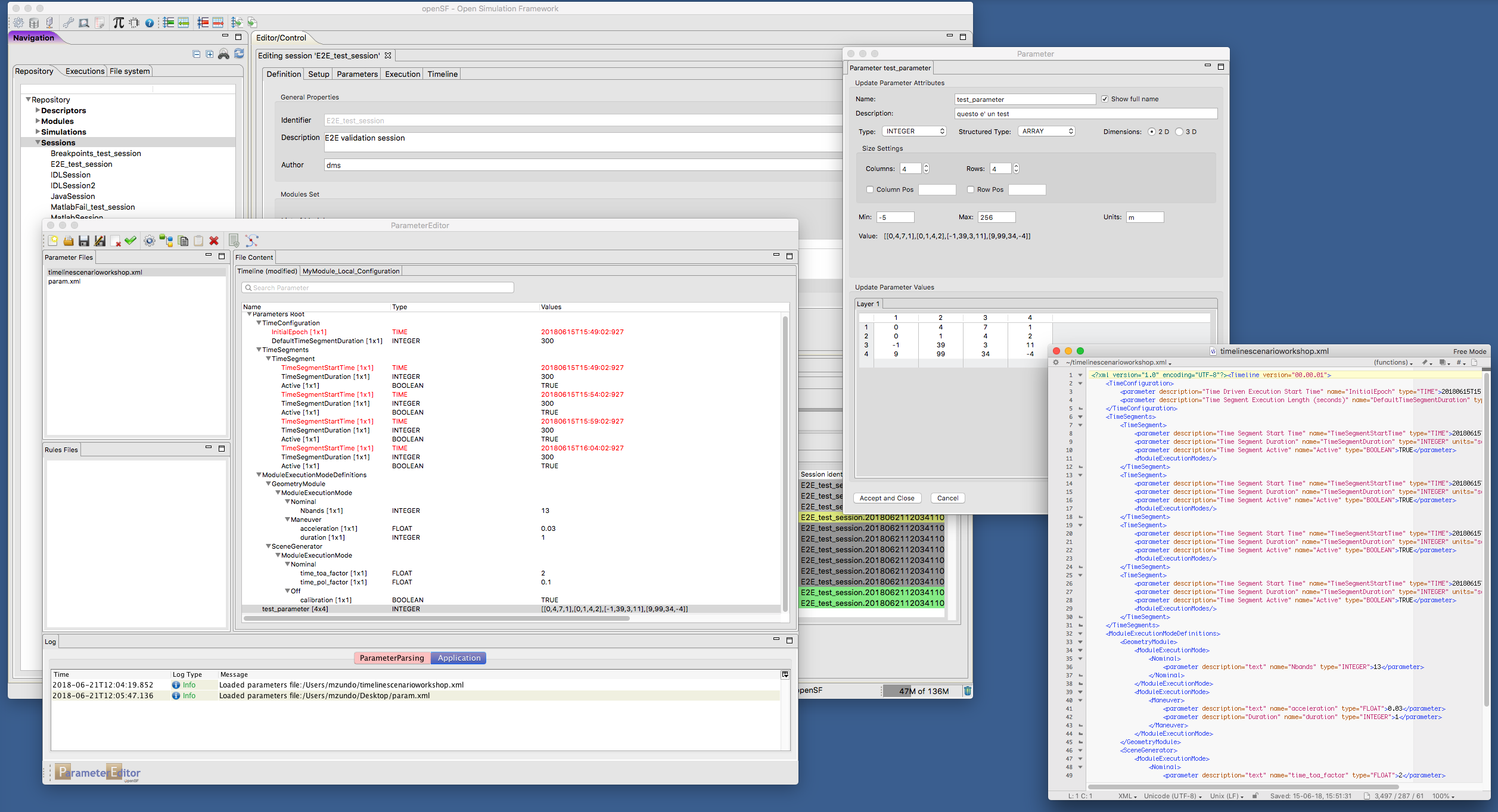
- Parameter Editor migrated to Eclipse RCP
- Improvements for the Parameter Editor:
· Remove/insert of columns/rows
· Allow copy/paste of a parameter
· Matrices/arrays “inline” separators dividing each dimension
· on-line validation of the configuration files
· parameter format check
- Option to split log files by module
- Improved logger exception handling and persistence
- Multi-line log messages tooltips (for message field)
- XSD validation now implemented in OSFI for all languages.
Corrections
- UI Persistence changing focus
- Fix refresh button not working on file system
- Fix problem of execution deletion deleting only DB entry and not session directory
- Fix assertion failed: S.TD != V.TD
- Preference pane in OSX does not work correctly
- Null Pointer Exception in session with complex types
- Scrollable tables sometimes return to the top
- Input folders are only copied partially
- Old-style arrays cause an exception if they include ndims > 1
- Bug in the session export feature: cannot find sql, log and zip files in OPENSF_HOME
- Views are not properly refreshed in GTK
- Empty window that not closes creating dialogs in Linux
- Clicking the “databases” button multiple times opens several instances of the related view
- The command-line options “-user” and “-password” are no longer accepted by the program
- When a new sub-view is opened, the parent view is not focused
- Abort session not working
- Time in PE is incorrect according to CCSDS ASCII format
Version 1.3 of SAMIEdit (SAtellite MIssions 3D visualisation application) has been released and can be downloaded here.
Release Notes are available here.
User registration is required. Please find detailed instructions here.
New Features
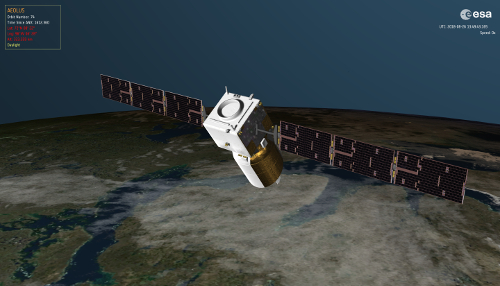
- Update of Aeolus 3D model
- Integration of EarthCARE 3D model and mission files
- EOCFI libraries updated to v4.14
- Improved switch between Manual and Timeline camera mode (through application menu)
- Project time window adjusted automatically when loading input orbit/attitude files outside time window
- Project time window adjusted automatically when switching to Real-Time mode
- Improved checks on project file contents (if referenced file does not exist)
- Made configurable the minimum elevation angle of the Ground Stations mask
- Highlight satellite info overlay of the satellite being displayed in the 3D satellite view (to distinguish satellites of the same constellation)
- Make editable the duration field of timeline blocks
- Swath contour internally regenerated whenever an orbit change takes place in an Orbit Scenario File
Corrections
- Fix step synchronisation problem with video export
- Mac OS X: Fix Earth distortion in Full screen mode
- Mac OS X: Improve rendering of fonts
- Remove 3D object shadowing during satellite eclipse
- Labels and text overlays changed from white to light grey colour to improve readability over Earth ice caps
Version 1.5.1 of the DFDL4S Java and C++ Libraries has been released and can be downloaded here.
DFDL4S is a generic binary data binding library written in Java and based on the Data Format Description Language (DFDL). DFDL++ provides the same functionality exposing a native C++ API. See more details here.
Improvements in version 1.5.1:
- Consolidation of DFDL4S public API
- A set of consistent public classes and methods is now available
- Classes and methods related to internal processing have been removed from the public API
- Harmonization of the DFDL4S (Java) API with DFDL4S++ (C++) API, so that the same functionality is provided in both languages
- Re-introduction of methods getChildAt() and getAvailableChildCount() in class Element, allowing an easy navigation of the Element’s tree
- Re-introduction of methods getError() and getChildErrors() in class Element, allowing to query the error status of interpreted binary data
Release Notes for DFDL4S Java are available here.
Release Notes for DFDL4S C++ are available here.
User registration is required. Please find detailed instructions here.
OpenSF v3.7.3 has been released and can be downloaded here.
Release Notes are available here.
User registration is required. Please find detailed instructions here.
New Features
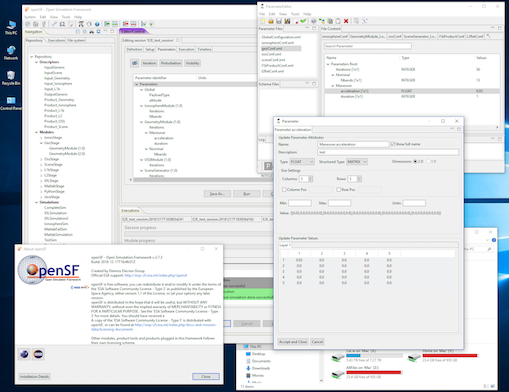
- OpenSF is now available for Windows 10
- Enabled grouping of execution results for iteration/perturbation-based sessions
- Enabled grouping of execution results for timeline-based sessions
- Enabled progress summary view for multiple executions sessions (e.g. timeline-based and iteration/perturbation-based sessions)
– instead of opening multiple dedicated progress tabs
- Enabled concurrent execution of independent modules in iteration/perturbation sessions
- Added XSD Validation in OpenSF and OSFI; enabled XSD validation in Parameter Editor
- Updated the Database access layer to make it independent of the DBMS (Database Management System)
- Adoption of ‘ESA Community License Type 3’ for openSF software distribution
Corrections
- Consolidated the timestamp format used for output filenames and folders
- Fixed ability to edit timeline segments (previously unable to edit due to overlapping empty tooltip)
- Added check to avoid setting timeline to empty
- Harmonization of the display of timestamps throughout the application
- Corrected incorrect mismatch error for Time arrays in Parameter Editor
- Updated the Timeline-based example in the validation test dataset
- Consolidated list of product tools in the validation test dataset
- Fixed behaviour when applying new application preferences (on MacOS)
- Fixed rendering issues of some table widgets (e.g. Log)
- Parameter Editor button icon was updated to ‘pi’

